
The Heart of Discipleship · Part 1 of 6
Isaiah 50:4–9: The Heart of Discipleship
At the core of discipleship is following Jesus. Although the phrase ‘to follow Jesus’ is often used, it is rarely understood. We usually think it means trying to love people the way Jesus loved them. This act of love is important, of course, but it only represents a part of what it means to follow Jesus. To follow Jesus doesn’t just mean knowing His teachings; it also means doing what He did. We are called to imitate the way He lived, including His ministry. This call to imitate does not mean we will do exactly what He did, but that we will approach life as He did. If we only imitate His works, we won't have the power to do what He desires for us (Eph 2:10). Ultimately, we won’t carry out His will. To truly imitate Christ’s ministry and care for others, we first need to be renewed in our lives by living like Him.
When I start to speak like this, people often become confused. They have never considered what it means to live like Jesus. Nor do they think about how Jesus received His power. They assume that Jesus naturally possessed this power to carry out a great ministry. As a result, most pastors are busy praying for more anointing. They don't realize that we can receive a greater anointing by having more of Jesus in us! Many of us see Jesus only as an extraordinary source of grace rather than the source of life and our works.
Jesus, the Servant
Philippians 2:7 gives us a clearer picture of Jesus. “But (Christ) emptied Himself, taking the form of a bond-servant, and being made in the likeness of men.” When Jesus came to earth, He set aside His rights and privileges as God. He understood God’s will and lived it out, just as we need to do, empowered by the Holy Spirit. When He performed miracles, it served as a model for how we should proceed. Of course, we are not yet skilled at doing these things, so it’s best for us to learn from Jesus, our Master.
Most Christians assume that Jesus used His supernatural abilities to perform great teaching and ministry. However, this is not true. If we are attentive, we will notice that Jesus prayed, faced dangers, lived, and suffered just like us. “For we do not have a high priest who cannot sympathize with our weaknesses, but One who has been tempted in all things as we are, yet without sin” (Hebrews 4:15). He lived like us to show how we should live.
Isaiah 50:4-9 offers a close look at Christ’s life during His time on earth and provides us with a practical way to follow Jesus in many ways. Learn how He nurtures His relationship with the Father and has the same attitudes He held. “Have this attitude in yourselves which was also in Christ Jesus” (Philippians 2:5). And, of course, we are to do His works. “Truly, truly, I say to you, he who believes in Me, the works that I do shall he do also; and greater works than these shall he do; because I go to the Father” (John 14:12).
Where does this leave us? Humbled and alert. This is just where God wants us to be. Suddenly, we realize that we have not learned well. We have not been closely following Jesus at all. There is so much to learn from Jesus. From the Gospels, we can get glimpses of Christ’s prayer life and relationships with others, but Isaiah 50:4-9 gives us an inside look. We do not just observe what someone recorded that He did, but we also get to see the principles that guided His thought and life.
Servant Songs
Tucked away in the Old Testament prophets are four Servant Songs. Each song features the Messiah speaking in the first person (“I” or “me”). They offer a view of Christ’s inner life. The Gospels describe how Jesus lived, while the New Testament epistles show the impact of His work. The Servant Songs powerfully reveal His heart (Isaiah 42:1-9, 49:1-7, 50:4-9, 52:13-53:12). Most readers of the Bible are only aware of the last Servant Song, Isaiah 53. That is where we see a vivid portrait of Christ on the cross, painted so clearly before our eyes, even though it was 600 years before His death.
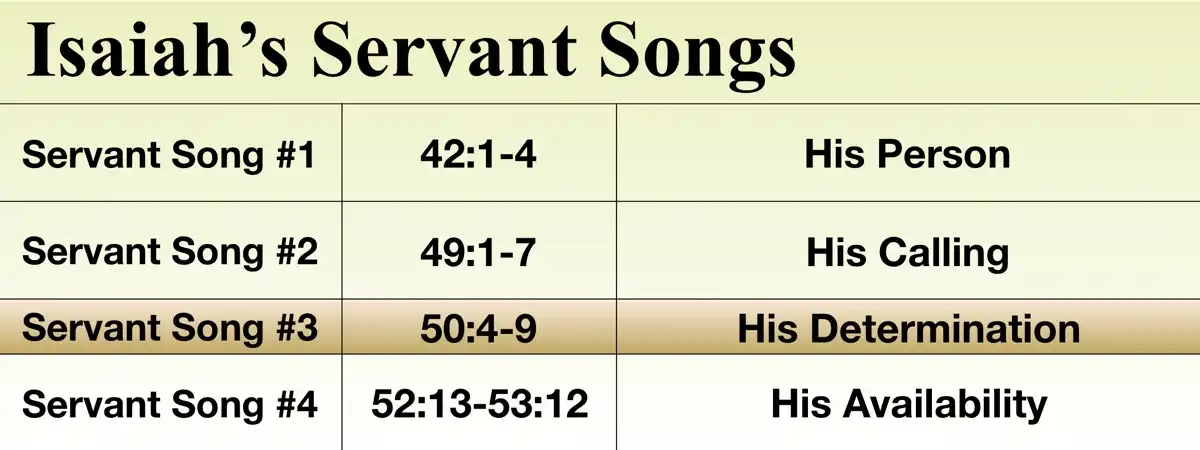
Study Christ’s Example
Just as the Queen of Sheba came to Solomon to seek wisdom, people from all around the world also come to Christ for His perspective on matters. We are not only seeking knowledge but also want to learn from Christ how to discern and carry out God’s will despite the many subtle challenges we encounter. May we pay close attention to Christ’s greater ways. When He came to earth, Christ relinquished His prerogative to use His divine powers. Let us focus on five key disciplines that He learned to accomplish what was necessary. The first four disciplines are found just in verse 50:4!
An Outline of Isaiah 50:4–9
- The Training of the Disciple: A disciple is a learner—learner for life.
- The Purpose of the Disciple: A disciple serves others—motivated to serve others.
- The Discipline of the Disciple: A disciple communes with God early each day—anticipates meeting with God.
- The Attention of the Disciple: A disciple attentively listens to and obeys God—completing God’s will.
- The Resolve of the Disciple: A disciple withstands difficulties to please His Master.
The Lord GOD has given Me the tongue of disciples, That I may know how to sustain the weary one with a word.
He awakens Me morning by morning, He awakens My ear to listen as a disciple. (NAB)The Sovereign LORD has given me an instructed tongue, to know the word that sustains the weary.
He wakens me morning by morning, wakens my ear to listen like one being taught. (NIV)
Scripture quotations are from the NASB unless otherwise noted.
Series Discussion Questions
- What makes it difficult to become a lifelong learner?
- Do you usually connect your training, experience, and spiritual knowledge to your needs or to helping others in need?
- How often do you commune with the Lord? What might help make it more effective?