
Jealousy Brings Anger
1 Samuel 18:8–10
Paul J. Bucknell
Watch the teaching video.
Listen to the teaching audio.
Jealousy becomes especially dangerous when anger distorts our interpretation of another person’s motives and makes destructive suggestions sound reasonable.
Then Saul became very angry, for this saying displeased him; and he said, “They have ascribed to David ten thousands, but to me they have ascribed thousands. Now what more can he have but the kingdom?” And Saul looked at David with suspicion from that day on (1 Samuel 18:8-9).
The author is very careful to note the source of Saul’s anger. The crowd’s applause, “And David his ten thousands,” displeased Saul intensely. Someone around his house or an advisor probably heard him say, “They have ascribed to David ten thousands, but to me they have ascribed thousands. Now what more can he have but the kingdom?” We are right to assume that Samuel’s words about having the kingdom torn from him came to his mind. All of a sudden it clicked in his mind. David was the one to replace him!
Sometimes we accept fate as it is portrayed, but we should remember that Saul could have turned away from his pride and humbled himself. Saul simply did not understand. Instead, he allowed a jealous spirit to wrongly interpret David’s motives. As we read on, we discover David’s humble life. What famous general do you know of that would go and play the lyre? David showed no signs of exalting himself. These are the things that Saul attributed to David. This is the distortion that happens when jealousy takes hold of someone’s soul (see diagram below).
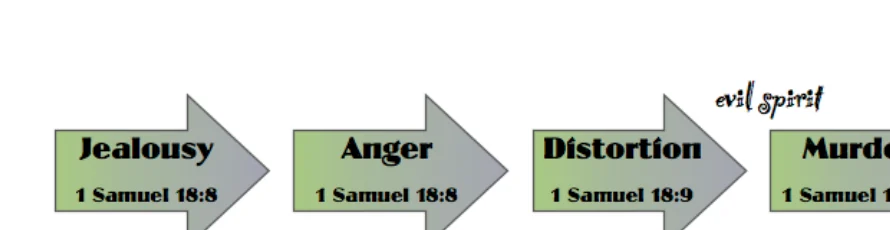
David, from this point on, became a marked man. Saul was determined to kill him. In fierce anger, he silently plotted to eliminate this threat to his throne.
- Was Saul envious of David’s success or jealous of losing his own throne?
- What things might you be afraid of losing to more capable people? How do you handle this?
Anger and the Evil Spirit
Then Saul became very angry, for this saying displeased him; and he said, “They have ascribed to David ten thousands, but to me they have ascribed thousands. Now what more can he have but the kingdom?” And Saul looked at David with suspicion from that day on (1 Samuel 18:8-9).
Some might dismiss the link between the evil spirit and anger, but that would be unwise. Perhaps they do this because they don't believe in evil spirits. From 1 Samuel 18:10, we see that at times of intense anger, the evil spirit actively influences the situation. Other questions are not clear from this passage, but they are very important to consider.
- What role does the evil spirit play in anger? How, for example, did it influence Saul?
- At what point does the evil spirit begin to influence a person in his anger?
- How can I escape the influence of the evil spirit in times of my anger?
Let me suggest the role of the evil spirit during times of anger. Perhaps it is not always this way, but the evil spirit does seek such opportunities, and he would often consider himself ‘invited’ when he sees bitterness and anger, much like how darkness gathers when the light goes out. Or perhaps it is like a person automatically looking for an open seat after boarding a crowded bus. The evil spirit seeks opportunities to deceive and control a person’s life. When a person enters a certain state of mind and heart, the evil spirit gains access to his life.
How does the evil spirit influence a person? It is clear from Jesus’ words that the evil spirit is not the source of hatred or bitterness, as these come from a person’s evil heart. We need to take responsibility for our jealous fits.
For from within, out of the heart of men, proceed the evil thoughts, fornications, thefts, murders, adulteries, deeds of coveting and wickedness, as well as deceit, sensuality, envy, slander, pride and foolishness. All these evil things proceed from within and defile the man (Mark 7:21-23).
The evil spirit influences the mind by bringing in thoughts and steering situations so that we would give further heed to our raging anger. He would stir us up by inserting insinuating phrases in our minds. “You aren’t going to let him get away with that, are you?” “What are you a fool? Don’t just let him steal your kingdom.” “Are you not king? Deal with that imp!”
Anger clouds our evaluative abilities, so an angry person is much more susceptible—like an open seat on the bus—to the suggestions of the evil spirit. The evil spirit’s suggestive voice seems convincing at that moment. Temptation sounds appealing because it wraps around and warms our inner evil desires. If we evaluate the action, we would see that David did not intend to steal Saul’s kingdom. But Saul harbored a wrong thought, which the evil spirit then used to help corrupt the rest of his life. “Saul looked at David with suspicion from that day on” (1 Samuel 18:9).
Believers can be influenced by evil spirits. They go to places where there is a seed of bitterness in a person’s heart. For example, if we hold bitterness because of what our parents did to us, we become vulnerable to further attacks from the evil one. God protects us through His rules. If we simply obeyed the Lord and honored our parents, we would be shielded. However, bitterness is a sign of rebellion and disrespect.
We might be far from our parents. They might even pass away. But that seed of bitterness takes root in us, enabling the evil spirit to cause turmoil in our souls and negatively influence how we handle disagreements with those around us.
We often mistakenly judge the work of the evil spirit in a believer by saying whether a person can or cannot be possessed. Instead, we should focus on living obedient lives and seeking protection from the evil spirit. Yes, temptation will still come, but being close to God makes it easier to recognize the subtle temptations by which He tries to lead us.
The more influence there is, the more likely we are to do wrong and follow his suggestions. In Saul’s case, we see that the evil spirit could and would sometimes exert a stronger influence on Saul, inciting him with crazy ideas like killing David. I think that when Saul believed a false conclusion about David, he let his jealousy take control, enough to even justify murdering him.
If we uncover the roots of anger and bitterness within us, there is probably also a seed of an unforgiving spirit. Or, as in Saul’s case, he believed something wrong about David, which fostered bitterness. Saul concluded that David wanted the throne and became extremely jealous. David wasn’t thinking that way (1 Samuel 18:23). He was not of royal blood. Even if David had such intentions, Saul should have turned to the Lord for help instead of letting jealousy control him.
- What place does the evil spirit have in anger? Slow-burning anger? Violent anger?
- When was the last time you got angry? Why?