
The Compromise for a King
1 Samuel 8:1–22
Paul J. Bucknell
B. Tough Consequences (1 Samuel 8:9-18)
We are somewhat surprised by the Lord’s response here. Why does the Lord respond the way He does to His people and just let them go on with their inferior plans?
The Lord’s Response (1 Samuel 8:9)
“Now then, listen to their voice; however, you shall solemnly warn them and tell them of the procedure of the king who will reign over them” (1 Samuel 8:9).
There are two parts to what He said. First, Samuel is to listen to them, meaning he should agree to give them a king. Second, he is to warn them about the consequences of having a king. Samuel does not begin by agreeing to their request but instead first explains the potential problems of having a king. He does this in hopes that they will turn away from their evil.
The Consequences (1 Samuel 8:10-18)
Samuel enumerated the difficulties of having a king.
“So Samuel spoke all the words of the LORD to the people who had asked of him a king. And he said, “This will be the procedure of the king who will reign over you: he will take your sons and place them for himself in his chariots and among his horsemen and they will run before his chariots…
“Then you will cry out in that day because of your king whom you have chosen for yourselves, but the LORD will not answer you in that day.” Nevertheless, the people refused to listen to the voice of Samuel, and they said, “No, but there shall be a king over us, that we also may be like all the nations, that our king may judge us and go out before us and fight our battles.” (1 Samuel 8:10-20).
Samuel highlighted many negative implications of having a king. He concentrated on the burdens a king would bear. The list is extensive because Samuel wanted them to reconsider their decision.
Consequences & Burdens
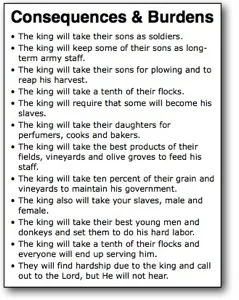
- The king will take their sons as soldiers.
- The king will keep some of their sons as long-term army staff.
- The king will take their sons to plow and reap his harvest.
- The king will take a tenth of their flocks.
- The king will require that some will become his slaves.
- The king will take their daughters to serve as perfumers, cooks, and bakers.
- The king will take the best products of their fields, vineyards, and olive groves to feed his staff.
- The king will take ten percent of their grain and vineyards to maintain his government.
- The king will also take your slaves, male and female.
- The king will take their best young men and donkeys and set them to do his hard labor.
- The king will take a tenth of their flocks, and everyone will end up serving him.
- They will face hardship because of the king and call out to the Lord, but He will not hear.
This is an extraordinary list. One must wonder why people still insist on having a king.
“Nevertheless, the people refused to listen to the voice of Samuel, and they said, “No, but there shall be a king over us, that we also may be like all the nations, that our king may judge us and go out before us and fight our battles” (1 Samuel 8:19-20).
They must have believed that their solution was worth more than the cost. This is very similar to what is happening in the world today. People are willing to sacrifice their freedom and wealth to make things safer, better, and more prosperous. It’s a reckless mistake. The costs outweigh the benefits. When people feel threatened or are simply lazy, the promises from governments and organizations just pull them into submission. There is a better way.
Samuel was giving them a second chance, but they refused to listen. What was driving all this? It seems they were so convinced that a king could better protect them from harm and preserve their wealth and peace of mind. Samuel boldly told them they would lose their wealth and families as they knew them. Yet, they didn’t care.